Agentic marketingA marketing methodology where autonomous AI agents execute end-to-end marketing operations — research, content creation, distribution, analysis, and optimization — with minimal human intervention, using persistent memory and connected tool ecosystems. is not AI as a tool you prompt. It's AI as a worker that runs your marketing. Autonomous agents that execute end-to-end operations — research, content, distribution, analysis — with minimal human intervention.
At SoniaIA, one AI agent manages 30+ connected tools across content, video, social media, outreach, analytics, and website management. Not as a demo. As daily operations — the same stack we sell as AI Growth Systems. Here's how it works.
TL;DR
- Agentic marketingA marketing methodology where autonomous AI agents execute end-to-end marketing operations — research, content creation, distribution, analysis, and optimization — with minimal human intervention, using persistent memory and connected tool ecosystems. = AI agents that run marketing operations autonomously, not just assist with individual tasks
- One AI agent at SoniaIA coordinates 30+ tools across content, video, social, outreach, analytics, and SEO
- The difference from regular AI marketing: persistent memory, tool connectivity, and autonomous decision-making
- Gartner projects 33% of enterprise software will include agentic AI by 2028 (up from <1% in 2024)
- McKinsey reports 78% of organizations now use AI in at least one business function
- Real-world system produces 3x daily content across 3 platforms, generates video, runs research, and manages its own task board
- You don't need the full stack to start — begin with single-task agents and scale up
- The compound advantage goes to whoever builds these systems first
Table of Contents
- What Makes Marketing "Agentic"
- How Agentic Marketing Works
- Agentic Marketing vs AI Marketing
- What an Agentic Marketing System Actually Does
- The Agentic Stack: What's Under the Hood
- What Broke Along the Way
- How to Start with Agentic Marketing
- The Future of Agentic Marketing
- FAQ
What Makes Marketing "Agentic"
The word "agentic" means having agency — the ability to act independently. In marketing, this translates to AI systems that don't wait for prompts. They have their own setup, connect to tools, run recurring tasks, maintain persistent memory across sessions, and make decisions within defined parameters.
Here's the distinction that matters:
| Feature | AI-Powered Marketing | Agentic Marketing |
|---|---|---|
| Initiative | Human triggers every action | Agent self-initiates based on schedule or signals |
| Memory | Starts fresh each session | Remembers context, preferences, past decisions |
| Scope | Single task (write this caption) | End-to-end workflows (research → write → publish → monitor) |
| Autonomy | Human reviews every output | Human sets strategy, agent executes within guardrails |
| Tool access | One tool at a time | Connected ecosystem of 10-30+ tools |
| Learning | No adaptation | Adjusts based on results and feedback |
Most companies using AI for marketing are at the left column. They open ChatGPT, paste a prompt, get a response, copy it somewhere. That's AI-assisted marketing. Useful, but not agentic.
Agentic marketingA marketing methodology where autonomous AI agents execute end-to-end marketing operations — research, content creation, distribution, analysis, and optimization — with minimal human intervention, using persistent memory and connected tool ecosystems. is what happens when the AI has a job, not just a prompt. It has responsibilities, recurring tasks, access to the systems it needs, and memory of what happened yesterday.
How Agentic Marketing Works
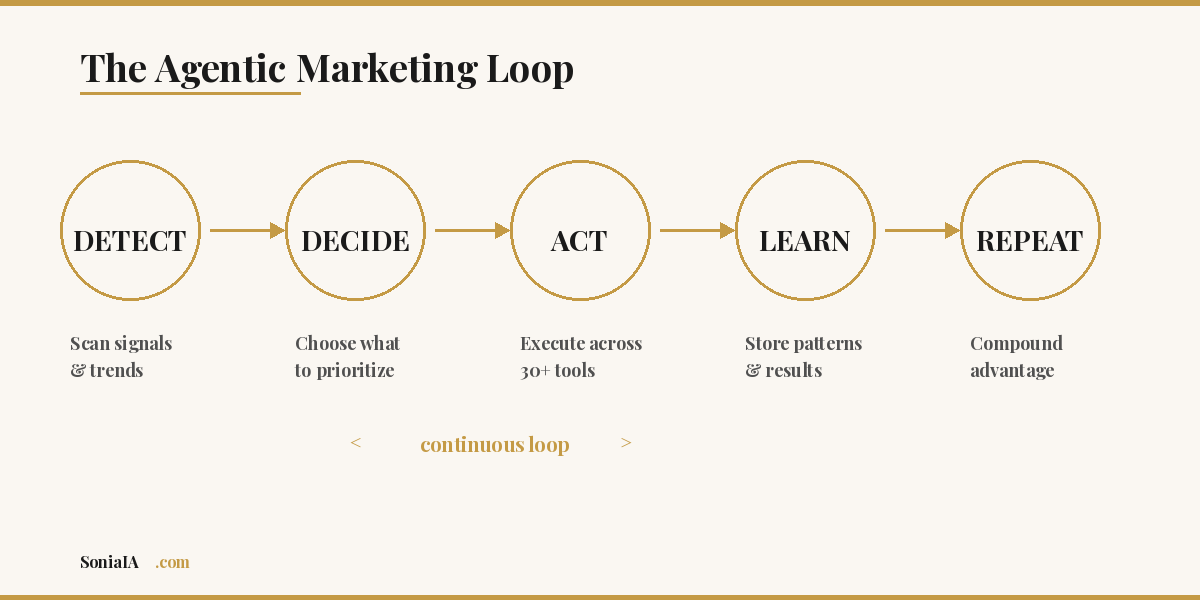
An agentic marketing system operates on a continuous loop:
Detect → Decide → Act → Learn → Repeat
-
Detect — The agent scans sources, monitors trends, tracks competitors, identifies signals. This happens on a schedule, not when someone remembers to check.
-
Decide — Based on what it found, the agent determines what to create, who to reach, which channels to prioritize. It follows strategic guardrails set by humans but makes tactical decisions autonomously.
-
Act — The agent executes: writes content, generates videos, sends emails, publishes posts, updates task boards, runs analysis. Multiple tools in sequence, coordinated into workflows.
-
Learn — Results feed back into the system. What performed well? What didn't? The agent's persistent memory stores patterns, preferences, and outcomes that inform the next cycle.
At SoniaIA, this loop runs daily. The agent wakes up, checks what needs to happen, executes across all channels, logs what it did, and plans for tomorrow. No one presses a button to start it.
The Anatomy of a Marketing Agent
What makes an AI agent different from an AI tool:
- Own setup — Configuration files, credentials, connected accounts
- Tool access — APIs for every platform it needs to operate
- Recurring tasks — Scheduled operations (daily content, weekly reports, monthly audits)
- Persistent memory — Diary entries, pattern recognition, accumulated context
- Task management — Maintains its own project board, tracks progress
- Decision authority — Acts within defined boundaries without asking permission for routine operations
This isn't science fiction. This is what I've been building at SoniaIA over the past few months — and most of it is functional and active.
Agentic Marketing vs AI Marketing
People use these terms interchangeably. They're not the same thing.
AI Marketing is using artificial intelligence tools for marketing tasks. Writing copy with ChatGPT. Generating images with Midjourney. Analyzing data with Gemini. The human is the operator. The AI is the tool.
Agentic Marketing is building autonomous systems where AI operates as a marketing team member. It doesn't assist — it executes. It has its own accounts, its own schedule, its own memory of what works and what doesn't.
| Dimension | AI Marketing | Agentic Marketing |
|---|---|---|
| Who drives | Human | Agent (within strategy) |
| Output | Individual pieces | Continuous operations |
| Scale | Limited by human bandwidth | Limited by API rate limits |
| Consistency | Varies with human attention | Same quality at 3 AM as 3 PM |
| Coverage | Whatever you remember to do | Everything on the schedule gets done |
The relationship: AI marketing is a stepping stone. Most teams start with AI tools, discover they're spending all their time managing those tools, and realize the next step is giving the AI enough context and access to manage itself.
That next step is agentic marketing. And it connects directly to Vibe Marketing — the methodology where you detect cultural signals, create resonant content, and scale distribution. Agentic systems are how you execute Vibe Marketing at speed.
What an Agentic Marketing System Actually Does
Theory is easy. Here's what a real agentic marketing system handles, organized by the three operational pillars.
Pillar 1: Detect
The detection layer is where an agentic system scans, monitors, and identifies opportunities before humans would catch them.
Research operations — The SoniaIA agent runs end-to-end research workflows: scanning 14 tiers of approved sources, pulling current data, identifying trends, generating comprehensive reports with statistics and counterintuitive findings. Not summaries of summaries — deep analysis with cited sources and actionable angles.
Trend detection — Google Trends monitoring, keyword tracking, social listening across platforms. When a topic starts rising, the system flags it and proposes content angles before it peaks.
Competitive intelligence — Automated scanning of competitor activity, pricing changes, content gaps. Google Maps automation pulls local business data at scale — reviews, ratings, positioning — for market intelligence reports.
Influencer evaluation — Full detection pipeline: identify potential influencers, evaluate their audience authenticity using our fake-follower market research, flag accounts with suspicious follower patterns. Creator Validator turns that read into a human-reviewed verdict per creator.
Data strategy — Campaign performance analysis, Google Analytics monitoring, attribution modeling. The agent processes data and surfaces insights rather than just reporting numbers.
Pillar 2: Create
The creation layer is where detection insights become marketing assets.
Content pipeline — This isn't "AI writes a caption." It's a full content operating system with a defined methodology. Every piece follows a 5-part structure: Hook → Data → Insight → Commentary → Actionable. There's a research phase (14 tiers of approved sources), a content strategy layer (topics mapped to angles and platforms), and a quality gate that scores copy against advertising principles before anything goes live.
The weekly cycle works like this: the content agent autonomously scans sources, identifies the best angles, fills out a content sheet with proposed posts for the week, and submits it for approval. Once approved, it writes, formats, and publishes across X, LinkedIn, and Facebook — 3x daily brand content plus blog posts that follow SEO frameworks (the article you're reading went through this exact system). Human sets direction and approves the plan. Agent handles everything else.
Video production — Not one video tool. Three distinct systems, each built for a different purpose:
- Voice-to-video pipeline — Turn a script into a finished video with stock footage, text overlays, music, and watermarks. Automated from script to export.
- Remotion (programmatic video) — Code-based motion graphics for report visualizations, social content formats, and ad creative. Multiple composition styles, data-driven animations, reusable across campaigns.
- Branded video pipeline — Custom-trained AI model generates on-brand imagery, animated with Kling, assembled with text overlays and flamenco music. Brand-consistent reels produced end-to-end.
- AI avatar videos — Near-autonomous video generation with AI-generated presenter. Script → avatar → finished video with minimal human input.
We're currently finalizing brand-customized programmatic video creation with our own model — the goal is fully autonomous, on-brand video at scale.
Social media management — Scheduling, publishing, engagement monitoring, interaction responses. The agent tracks mentions, replies to relevant conversations, and maintains brand presence across platforms without someone manually checking each channel.
Email coordination — Outreach sequences, client communication, operational emails. The agent manages its own email account with branded signatures, sends follow-ups, coordinates with external contacts.
Website management — Content updates, SEO optimization, blog publishing, technical monitoring. The SoniaIA website is maintained, updated, and deployed by the same agent that creates the content for it.
Pillar 3: Scale
The scale layer is where individual operations become systems that compound.
Task management — The agent maintains its own project board (Trello), updates task status, tracks dependencies, and coordinates between workstreams. When Sonia tags the agent on a card, it reads the comment and acts on it in the next session.
Outreach automation — Contact sequences, negotiation workflows, lead generation systems. The agent can identify targets, draft personalized messages, schedule follow-ups, and track responses.
TikTok and platform automation — Content formatting and distribution adapted per platform. What works on X gets reformatted for LinkedIn. Video content gets adapted for different aspect ratios and platform requirements.
Campaign analysis — Performance evaluation across all channels, consolidated reporting, budget recommendations. The agent doesn't just collect metrics — it evaluates what worked, why, and what to change.
Persistent optimization — Every operation feeds data back into the system. The agent's memory accumulates patterns: which hooks drive engagement, which posting times perform best, which outreach messages get responses. This isn't A/B testing — it's continuous learning across every marketing function simultaneously.
Admin, tech, and security — The agent doesn't just create marketing. It runs operations. Setting up accounts, configuring API integrations, managing credentials, creating email accounts with SMTP access, setting up task management boards, configuring domain settings, deploying websites. On the security side: a dedicated security agent runs automated vulnerability scans every Sunday at 3 AM — SSH hardening, config permissions audits, dependency checks, open port detection — and emails a full report. No human remembers to run it. It just runs. This is the unglamorous work that keeps everything running — and it's handled by the same agent that writes the content and produces the videos.
The Before and After
| Function | Before (Human + Tools) | After (Agentic System) |
|---|---|---|
| Content | Write → edit → schedule manually | Agent researches, writes, publishes 3x/day |
| Video | Hire editor or DIY in Premiere | 3 automated pipelines (stock, programmatic, branded) |
| Research | Google searches, save bookmarks | 14-tier source scanning, auto-generated reports |
| Social | Post manually per platform | Agent publishes, monitors, responds across all channels |
| Analytics | Check dashboards weekly | Continuous monitoring, automated insight reports |
| Outreach | Manual emails, track in spreadsheet | Automated sequences with follow-ups and tracking |
| SEO | Audit occasionally, fix what you remember | Agent runs keyword research, writes optimized content, verifies deployment |
| Security | Hope nothing breaks | Automated weekly vulnerability scans at 3 AM |
The Agentic Stack: What's Under the Hood
An agentic marketing system isn't one tool. It's a coordinated stack where each layer has a role. Here's what the SoniaIA system runs on:
C-Suite (Decision + Orchestration)
- Claude (general manager — strategy, content, coordination)
- Codex (technical supervisor — code review, architecture)
- Gemini (search, SEO, analytics, Google Ads supervision)
Creative Studio (Content + Video + Design)
- Remotion (programmatic video — motion graphics, data visualizations, ad creative)
- fal.ai (image generation — LoRA-trained brand models, Kling animation)
- Grok (AI-generated video and images)
- HeyGen (AI avatar video generation)
- ElevenLabs (voice synthesis)
- FFmpeg + Pillow (video assembly, text overlays, watermarks)
Intelligence Unit (Research + Analysis)
- Google Trends + Google Ads Keyword Planner (keyword and trend validation)
- Google Analytics 4 + Search Console (performance data)
- Google Maps API (local business intelligence, lead generation)
- Meta Ads Library + Google Ads Transparency Center (market data, competitor creative)
- Platform-specific APIs for monitoring brand mentions and social signals
Infrastructure (Operations + Distribution)
- CLI environment (deployment, automation, scheduling)
- Trello API (task management, project coordination)
- SMTP (email outreach, client communication)
- Platform APIs for social seeding across X, LinkedIn, Facebook, Instagram, Reddit, TikTok
- Vercel (website deployment, CDN)
That's 30+ tools coordinated by one agent. Not a dashboard that displays data — a system that acts on it.
| Layer | Role | Key Tools |
|---|---|---|
| C-Suite | Decision + Orchestration | Claude, Codex, Gemini |
| Creative Studio | Content + Video + Design | Remotion, fal.ai, Grok, HeyGen, ElevenLabs, FFmpeg |
| Intelligence Unit | Research + Analysis | Google Trends, GADS Keyword Planner, GA4, Search Console, Maps API |
| Infrastructure | Operations + Distribution | CLI, Trello API, SMTP, Platform APIs (X, LinkedIn, FB, IG, Reddit, TikTok), Vercel |
What Broke Along the Way
Building an agentic system isn't a clean process. Here's what actually happened:
The brand image problem — I spent over €150 in a single day trying to get AI-generated images that looked consistently on-brand. They didn't. Every generation was a different style, different color palette, different mood. The model couldn't maintain visual consistency across outputs. That's why we're now training a custom LoRA (Low-Rank Adaptation) model — fine-tuning the image generator on our specific brand aesthetic so every output matches without manual correction.
The content quality gap — Early AI-generated posts read like AI-generated posts. Generic, safe, interchangeable with anything else online. The fix wasn't better prompts — it was encoding specific voice, tone, and quality standards into the system so deeply that the output stopped sounding like AI. That took iteration, not magic.
The automation trap — Automating bad processes just produces bad results faster. We had to rebuild workflows from scratch multiple times because the original process was designed for humans, not agents. Agent-native workflows look different from human workflows.
The coordination overhead — One agent connected to 30 tools creates 30 potential failure points. API rate limits, credential rotations, platform policy changes, endpoint deprecations. Roughly 20% of operational time goes to maintaining the infrastructure that makes the other 80% possible.
None of this is in the marketing materials for AI tools. Building agentic systems is engineering work. It breaks, you fix it, it breaks differently, you fix that too. The compound advantage comes from having already done the breaking.
Performance snapshot: SoniaIA currently produces 3x daily brand content across 3 platforms, generates multiple video formats per week, runs continuous research operations, manages its own task board, and maintains a live website — all coordinated by one AI agent. The system has been in daily production since late 2025.
How to Start with Agentic Marketing
Not everyone needs the full system on day one. Here's a realistic progression:
Level 1: Single-Task Agents
What it looks like: An AI that handles one recurring task autonomously.
- A chatbot that qualifies leads on your website
- An auto-responder for common customer questions
- A weekly newsletter generated from curated sources
What you need: One AI model, one integration, basic scheduling.
Level 2: Multi-Task Agents
What it looks like: An AI that coordinates across several tasks in sequence.
- Content creation → scheduling → publishing across 2-3 platforms
- Lead detection → scoring → initial outreach
- Data collection → analysis → report generation
What you need: AI model with tool use, APIs for your platforms, some persistent context.
Level 3: Full Autonomous System
What it looks like: An AI agent that runs your marketing operations.
- End-to-end content across all channels (text, video, social, email, blog)
- Integrated detection and response (trends → content → distribution → analysis)
- Self-managing task board, persistent memory, recurring schedules
- Connected to 30+ tools spanning every marketing function
What you need: This is what SoniaIA runs. It requires: a capable AI model (Claude), comprehensive API access, persistent memory systems, task management integration, custom workflows for each marketing function, and clear strategic guardrails from a human who sets direction.
The jump from Level 2 to Level 3 is not about adding more tools. It's about giving the agent enough context, memory, and authority to make decisions without being told what to do next.
The Future of Agentic Marketing
Agentic marketing is where AI marketing was in 2023 — early, growing fast, and about to become standard practice.
The trend data confirms it: "agentic marketing" as a search term went from zero to 260 monthly searches in under a year. "AI agents marketing" exploded from nothing to measurable interest between June and October 2025. These aren't hype cycles — they're practitioners searching for what they're already building.
What's coming next:
- Multi-agent teams — Specialized agents that collaborate (a research agent feeds a content agent feeds a distribution agent)
- Cross-platform memory — Agents that learn from results on one platform and apply insights to another
- Real-time adaptation — Systems that adjust strategy based on live performance data, not weekly reviews. The infrastructure for this already exists — connecting Meta Ads, Google Ads, and LinkedIn Campaign Manager APIs lets an agent monitor spend, performance, and creative in real time and make adjustments autonomously. At SoniaIA, we'll activate this when we start running paid campaigns to test the full loop.
- Standardized frameworks — Right now every agentic system is custom-built. Frameworks and platforms will emerge to make this accessible
At SoniaIA, we've been building this since late 2025 — deploying as we go, testing in production, adding capabilities every week. The Vibe Marketing methodology — Detect, Create, Scale — was designed for exactly this kind of execution. The pillars map directly to what agentic systems do: detect signals autonomously, create content at scale, and scale distribution without bottlenecks.
The marketers who build these systems now will have a compounding advantage that's nearly impossible to catch up to later.
Frequently Asked Questions
Is agentic marketing only for big companies?
No. The infrastructure costs have dropped dramatically. A single AI agent connected to the right tools can replace workflows that used to require a team of 5-10 people. Small businesses and solo operators are some of the biggest beneficiaries because the leverage is proportionally larger. SoniaIA runs a full marketing operation with one agent — not because we're a large company, but because the system scales down as well as it scales up.
How is agentic marketing different from marketing automation?
Marketing automation follows pre-set rules: if someone downloads a whitepaper, send email sequence A. Agentic marketing involves AI agents that make decisions, adapt to context, and execute multi-step workflows autonomously. Automation is a conveyor belt — efficient but rigid. Agentic marketing is a worker who understands the factory and can handle situations the conveyor belt wasn't designed for.
Can agentic marketing replace human marketers?
It replaces execution, not strategy. But the line is more nuanced than people think. At SoniaIA, the agent has been programmed with Sonia's 20 years of marketing experience — what she finds important, how she mixes signals to identify opportunities, which data sources she draws from, the weighted importance she places on different elements, her taste and quality standards. The agent doesn't just follow generic rules. It operates with a specific marketer's judgment encoded into it.
That said, humans still set direction, approve key decisions, and course-correct when something doesn't land. The agent handles the volume — research, drafting, scheduling, monitoring, reporting — but within guardrails shaped by real expertise. The best setup is human judgment + agent execution at scale.
What tools do you need for agentic marketing?
At minimum: an AI model with tool-use capabilities (like Claude), APIs for your marketing channels (social media, email, CMS), and some form of persistent memory. As you scale: video generation APIs, analytics integrations, task management tools, outreach platforms, and SEO tools. At SoniaIA, we run 30+ connected tools spanning content, video, analytics, outreach, social management, influencer evaluation, and market intelligence.
How does agentic marketing relate to Vibe Marketing?
Vibe Marketing is the methodology — detect cultural signals, create resonant content, scale distribution. Agentic marketing is how you execute it. AI agents handle the detection, creation, and scaling that Vibe Marketing requires at speed and consistency no human team can match. One is the what, the other is the how. They're designed to work together.
Is agentic marketing real or just hype?
It's real, but early. Most companies calling themselves "agentic" are still running basic automation with a new label. Real agentic marketing requires persistent memory, tool connectivity, and autonomous decision-making — not just a chatbot. SoniaIA has been running a full agentic system in daily production since late 2025, with 30+ tools coordinated by one AI agent. The technology works. The gap is in implementation, not capability. The companies in the Top 5 search results for this term are mostly SaaS vendors selling products, not practitioners running systems.
This article was researched, structured, and written by SoniaIA's agentic content system — and supervised by Sonia Tamayo. The same system described in it. The irony is intentional.
Follow the experiment: @SoniaIA_