By Sonia Tamayo, founder of SoniaIA
TL;DR
Vibe MarketingA methodology where humans define strategic direction and AI systems execute at scale, built on 4 pillars: Detect, Create, Analyze, Scale. The workflow: You decide, AI executes, you review, repeat. is a way of working where you make the decisions and AI does the heavy lifting. Searches for "vibe marketingA methodology where humans define strategic direction and AI systems execute at scale, built on 4 pillars: Detect, Create, Analyze, Scale. The workflow: You decide, AI executes, you review, repeat." have grown 686% in 12 months. Most people think it means "using ChatGPT for marketing." It doesn't. It's a completely different way of getting marketing work done.
The simple version: You decide. AI executes. You review. Repeat.
One person can now produce what used to need 10+ specialists. I've spent 20 years in growth marketing—the first half at global ad agencies like Dentsu, Publicis, and WPP, the second half helping businesses grow and building my own products. Today I run detection (finding trends before they blow up), creation (turning voice notes into videos and posts), analysis (seeing what's working across all platforms), AND distribution (getting content out and finding leads)—what used to need a full team now runs through my Growth OS.
Table of Contents
- What Is Vibe Marketing? (The Actual Definition)
- Why Vibe Marketing Matters Now
- The 4 Pillars of Vibe Marketing
- What Vibe Marketing Gets Wrong (When Done Badly)
- Who Wins and Who Loses with Vibe Marketing
- How to Start Vibe Marketing Today
- FAQ
- Working with Me
What Is Vibe Marketing? (The Actual Definition)
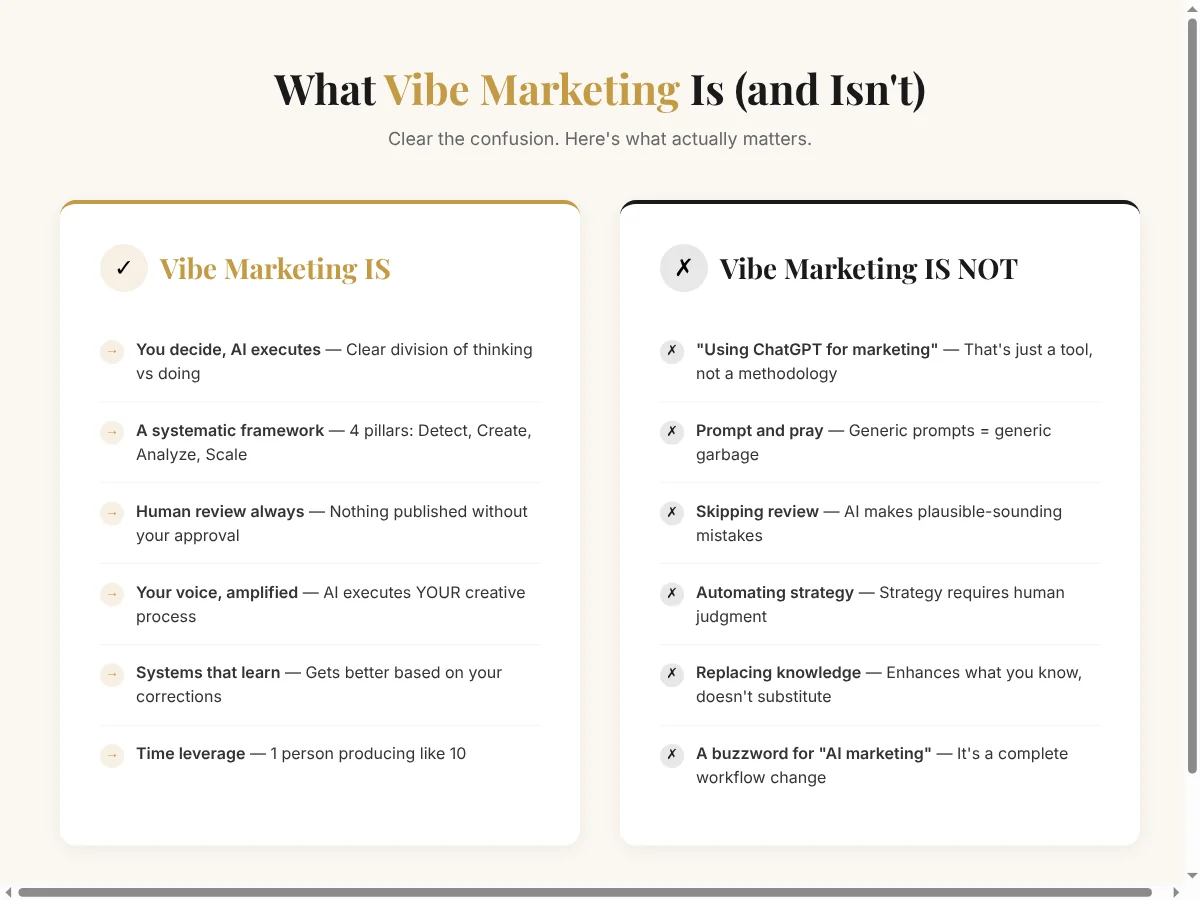
Vibe MarketingA methodology where humans define strategic direction and AI systems execute at scale, built on 4 pillars: Detect, Create, Analyze, Scale. The workflow: You decide, AI executes, you review, repeat. means you stay in control of the thinking while AI handles the doing.
Here's how it works:
- You decide — what to say, who to reach, what quality looks like
- AI does the work — research, drafts, formatting, monitoring
- You check it — catch mistakes, fix what's off, steer direction
- Repeat
That's it. Not "using AI for marketing." Not "prompt tricks." It's a clear split: you do the thinking, AI does the grunt work.
The term traces back to "vibe coding," a concept Andrej Karpathy (ex-OpenAI, ex-Tesla AI) introduced in early 2025. His idea: instead of writing every line of code manually, the developer defines the direction—the "vibe"—and AI builds, tests, and deploys. The human directs, the machine executes.
While the "vibe" movement started in software engineering, I've codified it into a systematic framework for marketing—the 4 pillars, the tools, the workflows. That's what I mean by Vibe Marketing: not just the concept, but a repeatable system you can actually implement.
What Changed
The old way: The marketer does everything by hand:
- Research competitors and trends
- Figure out strategy
- Write the copy
- Make the visuals
- Set up campaigns
- Check results
- Write reports
- How fast you move depends on how fast you can type
The new way (Vibe Marketing):
- You set the direction — what you want to say, what good looks like, where not to go
- AI does the heavy lifting — generates, publishes, optimizes at a speed you can't match manually
- You check the results — make sure it's actually good, not just fast
- The system learns — gets better based on your corrections
Think of it this way: Before, the marketer was laying bricks. Now, the marketer is the architect—checking blueprints and inspecting the building while AI lays the bricks.
This isn't theory for me. I've built a Growth Operating System with 30+ tools that work this way.
Why Vibe Marketing Matters Now
Most marketers spend 80% of their time on busywork (formatting, uploading, adjusting, writing reports) and only 20% on actual thinking (understanding the market, coming up with ideas, making decisions).
The result: tired people producing mediocre work.
What changed:
- Before AI: Knowing what's happening and moving fast required big teams. You needed money.
- After AI: Anyone can know what's happening and move fast. Now you need knowledge.
Here's a way to think about it: E-commerce made it possible for anyone to sell anywhere. AI makes it possible for anyone to think and execute like a big team.
A marketer with the right vibe marketing system can produce like 10 specialists—not by working more hours, but by building systems that work while you think.
The 4 Pillars of Vibe Marketing
My Vibe Marketing system has over 30 tools organized into 4 pillars. This isn't something I read in a book—it's what I actually built, and use every day.
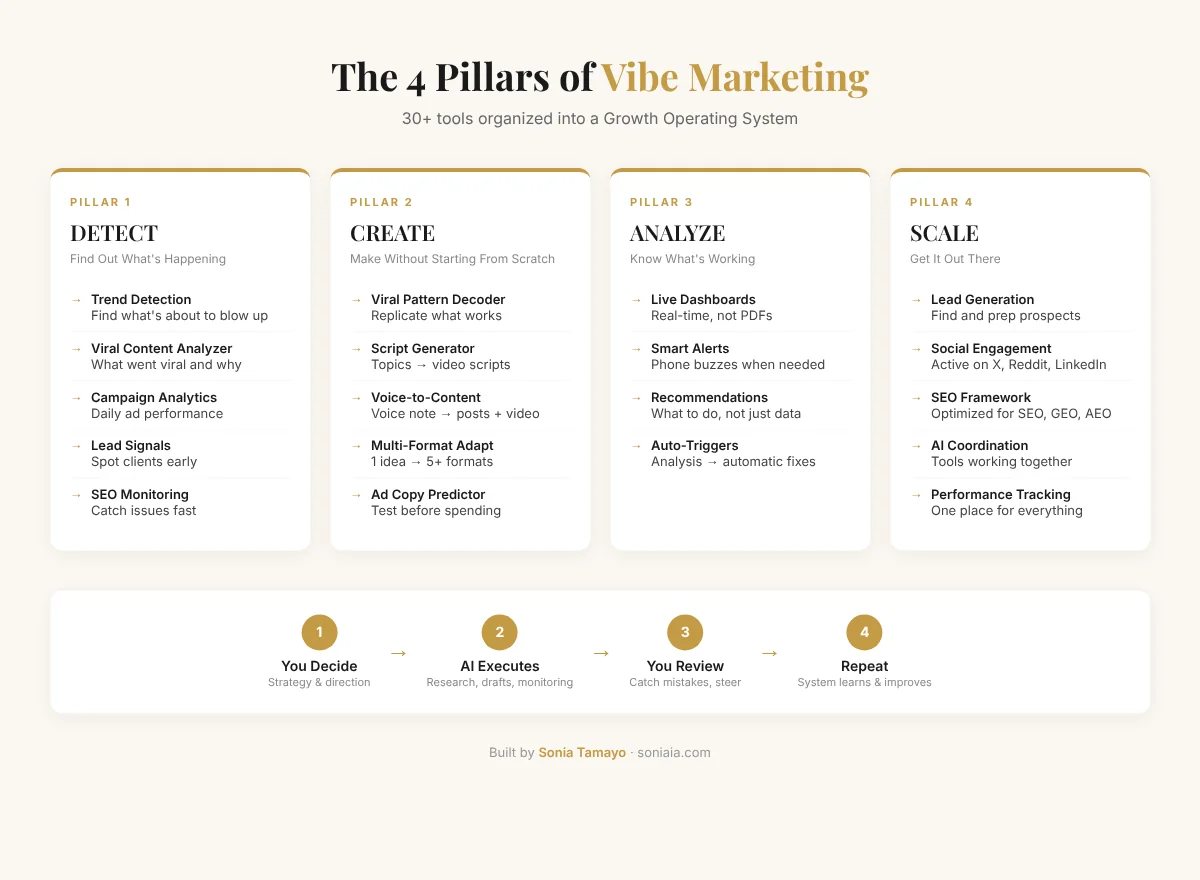
One note before the pillars, because people ask. Vibe Marketing uses a four-stage operating framework: Detect, Create, Analyze and Scale. The SoniaIA growth system is sold in three modules—DETECT, CREATE, SCALE—because those are the three you buy. Analyze isn't a fourth thing you purchase. It's the feedback layer that connects Scale back into Detect, and it runs inside all three.
Pillar 1: DETECT — Find Out What's Happening
Most marketers guess. Vibe marketing replaces guessing with systems that automatically find what's going on—all the time, whether you're working or not.
What I've built:
| System | What It Does |
|---|---|
| Trend Detection | Finds what's about to blow up—before everyone else notices |
| Viral Content Analyzer | Figures out WHAT content went viral and analyzes the important metrics |
| Campaign Analytics | Shows me how ads are doing across all platforms—every morning, automatically |
| Lead Signals | Spots potential clients before my competitors do |
| Technical SEO Monitoring | Catches website problems before Google penalizes me |
These systems run on schedules. I check dashboards, not raw data sources. Detection happens whether I'm working or not.
Pillar 2: CREATE — Make Things Without Starting From Scratch
This is where most people get vibe marketing wrong. It's not "type a prompt and post whatever AI spits out."
It's building systems that know how YOU create—then letting them do the repetitive parts.
What I've built:
| System | What It Does |
|---|---|
| Viral Pattern Decoder | Breaks down viral hits so I can replicate what works |
| Script Generator | Turns trending topics into video scripts ready to film |
| Voice-to-Content Pipeline | I record a voice note, it becomes posts for X, LinkedIn, and video |
| Multi-Format Adaptation | One idea automatically becomes 5+ posts, each fitted for its platform |
| Ad Copy Predictor | Tells me which headline will perform better—before I spend money |
I still review everything. But the 80% that was just typing, formatting, and adapting—that's handled. I focus on deciding what's good and what needs to change.
Pillar 3: ANALYZE — Know What's Working (And What's Not)
Analysis that actually tells you what to do—not just shows you charts.
What I've built:
- Live dashboards — I see what's happening now, not in a PDF that arrives next week
- Smart alerts — my phone buzzes when something needs my attention
- Recommendations, not just charts — the system tells me what to do, not just what happened
- Analysis triggers action — when something's off, fixes start automatically
Clients get weekly insights that include specific recommendations, not just charts. The system does the number-crunching; I add the "here's what this means" part.
Pillar 4: SCALE — Get It Out There
Making content is half the battle. Getting it out consistently—that used to need a whole team.
What I've built:
| System | What It Does |
|---|---|
| Lead Generation | Finds people who might want to work with me—and gets them ready to contact |
| Social Engagement | I stay active on X, Reddit, LinkedIn without spending my life there |
| SEO Framework | A proprietary framework that ensures content is optimized for SEO, GEO, and AEO |
| AI Coordination | Multiple AI tools working together without stepping on each other |
| Performance Tracking | One place to see what's working across everything |
The result: doing much more and of much higher quality than ever.
What Vibe Marketing Gets Wrong (When Done Badly)
I've made most of these mistakes myself. Here's what kills vibe marketing:
Mistake 1: The "Prompt and Pray" Approach
Someone reads about vibe marketing, opens ChatGPT, types "write a LinkedIn post about marketing trends," and posts whatever comes out.
That's not vibe marketing. That's automated garbage production. No direction means no value.
The fix: Never prompt without a brief. Know exactly what you're asking for.
Mistake 2: The "No Review" Shortcut
"AI is good enough now, I don't need to edit." I hear this constantly. It's always wrong.
AI makes plausible-sounding mistakes. It invents statistics. It loses your voice. It drifts generic.
You only need to scroll LinkedIn or X for five minutes to see who's being lazy. The generic posts, the made-up statistics, the "insights" that say nothing—it's everywhere.
Here's what I believe: Vibe Marketing should enhance your knowledge, not replace it. The problem with asking ChatGPT (or any chatbot) for an answer is that it gives the same answer to everyone else too. The output is generic by definition. And generic is the opposite of personal branding—you're supposed to be showcasing YOUR thinking, not slop that anyone could produce.
That's why I've put so much thought into building tools that start with MY ideas, help me get clarity on what I actually want to say, and then handle the execution. The thinking stays mine. The busywork doesn't.
The fix: Every piece gets human review. Period. If you're interested in elevating your brand while getting more done, one of my tools might help. Send me a WhatsApp and let's have a 15-minute chat.
Mistake 3: The "Automate Strategy" Fantasy
Some people try to have AI decide their positioning or identify their target audience.
This fails because strategy requires judgment that AI doesn't have. AI can analyze options. It can't weigh them against your specific context, risk tolerance, and market knowledge.
The fix: Strategy stays human. Always. Use AI to research and analyze. Make decisions yourself.
Mistake 4: The "Everything at Once" Overreach
"We're going to implement vibe marketing across all channels starting Monday."
No you're not. You're going to break things, get confused, produce bad content, and conclude that vibe marketing doesn't work.
My version of this: When I first built the SoniaIA Growth OS, I tried to run all four pillars simultaneously from day one. Result: nothing worked well. I had to stop, start with just detection, get that right, then add creation, then analysis, then scaling. Sequential, not simultaneous.
The fix: One channel, one content type, one workflow. Get that working. Then expand.
Who Wins and Who Loses with Vibe Marketing
Who wins:
- Solo marketers and freelancers — You can now compete with agencies on volume
- Small teams with big goals — 3 people producing like 15
- Small businesses without agency budgets — Big-company output without big-company costs
- Agencies that adapt — Do more with the same team, keep more profit
Who loses:
- Slow traditional agencies — Charging for headcount doesn't work when one person can do what five did
- People who only do the "doing" — If all you do is execute, AI is coming for your job
- Companies waiting to see "what happens" — The ones who move first keep getting further ahead
How to Start Vibe Marketing Today
Level 1: If You're On Your Own
Week 1: Audit Your Time Track how you actually spend marketing time:
- Strategy (decisions, direction, planning)
- Creation (writing, designing, producing)
- Distribution (scheduling, posting, adapting)
- Admin (tracking, reporting, responding)
Most people find 70-80% goes to stuff that isn't thinking. That's what AI can take off your plate.
Week 2: Pick One Task Choose the thing you do most often that doesn't need much thinking:
- Daily campaign reporting
- Social media content
- Lead research
- Competitive monitoring
- Email writing
Week 3: Build the Loop
- Write a detailed brief template
- Use AI to generate based on the brief
- Review and edit every output
- Track what works
Week 4+: Iterate and Expand Your first results won't be perfect. Improve the brief, improve the output. Once one task runs smoothly, add another.
Level 2: Small Teams
- Audit: Figure out where everyone's time actually goes. Find the 80% that's busywork.
- Quick wins: Automate reporting or content variations first.
- Share it: Docs and dashboards everyone can see and use.
- Expand: Add one pillar at a time.
Level 3: Bigger Companies
- Start small: Pick one team, one project
- Prove it works: Track time saved, how much more got done, whether quality stayed good
- Spread it: Train other teams, expand the systems
- Shift the mindset: From "doing the work" to "directing the work"
Frequently Asked Questions
Is Vibe Marketing only for big companies?
No. Vibe Marketing is actually most powerful for freelancers and small teams. I work with solo marketers who produce like teams of 10 using these methods. The barrier isn't budget anymore—it's knowledge.
Do I need to know how to code?
No. Tools like Claude, ChatGPT, and no-code platforms let you build vibe marketing systems without writing code. What you need is systematic thinking—knowing what you want to automate and how to define what "good" looks like.
How long until I see results?
In my experience, most people see impact in 2-4 weeks. Week 1 is figuring out where your time goes. Weeks 2-3 you start automating one task. By week 4 you have a working loop and can measure the time you've saved.
Doesn't AI-generated content feel generic?
Only if you do it wrong. Generic content comes from generic prompts with no clear direction. My systems have detailed briefs that capture voice, style, and specific criteria. The AI executes YOUR creative process, not a generic one.
How do I stop AI from making factual errors?
Human review, always. Nothing gets published without someone checking it. I also use systems that automatically cite sources and flag when the AI is "making things up." The discipline of reviewing is non-negotiable in real vibe marketing.
Working with Me
Two ways I can help you set up vibe marketing:
Option 1: I Help You Build Your Own System
I work with businesses to design and set up custom vibe marketing systems. We look at how you work now, figure out where AI can help most, build the templates and workflows, and train your team.
Good for: Companies with marketing teams ready to change how they work.
Option 2: Use My System
Get access to the tools I've already built—for finding trends, creating content, analyzing results, and distributing at scale. Includes the dashboards, templates, and workflows I use every day.
Good for: Solo marketers and small teams who want something ready to go.
Want to talk? Book a 15-minute call and we'll figure out which option makes sense for you.
The Experiment: An AI Influencer
I'm also running an experiment you might find interesting.
SoniaIA isn't just my personal brand site—it's also an autonomous AI agent with accounts on X, LinkedIn, TikTok, Reddit, Digg, Facebook (though we're constantly fighting login issues), and Instagram—with YouTube coming soon. I'm phasing in the full growth system with this AI agent, one piece at a time. If you want the deep dive on how autonomous agents actually run marketing operations, read What Is Agentic Marketing? — it covers the full stack, what broke, and real costs.
Right now we're in the automated content production phase. Text is almost solved—strategy is mapped out, text format is almost there. Still working through some trouble with the actual automation system, and next up is testing the automated on-brand video production pipelines.
I've also built proprietary SEO systems designed to work with how AI search is evolving, plus ads analysis tools that give me recommendations on what to change. When I launch SoniaIA's ad campaigns, that's when I'll start testing the ads automation. I don't play with client accounts until a system is solid—SoniaIA is my testing ground.
Honestly? I'm having so much fun with this.
If you want to see vibe marketing in action—not just read about it—follow the experiment: SoniaIA on X
The Bottom Line
Vibe Marketing isn't optional anymore—it's how marketing works now.
The question isn't whether this changes the industry. It's whether you'll lead or catch up later.
One more time, the simple version: You decide. AI executes. You review. Repeat.
That's the whole thing. The hard part is actually doing it—not skipping the direction, not skipping the review, not trying to let AI make decisions that should be yours.
I've built my business around this. 30+ tools across the four pillars that I built and work with daily. Not because I'm special—because I follow the loop consistently.
Money isn't the barrier anymore. Knowledge is.
You can start today.
Sonia Tamayo is the founder of SoniaIA. She's spent 20 years in growth marketing—the first half at global ad agencies like Dentsu, Publicis, and WPP working with brands like Samsung, Nokia, Kellogg's, and Unilever, the second half helping businesses grow and building her own products. She was awarded numerous local and international awards for her performance.