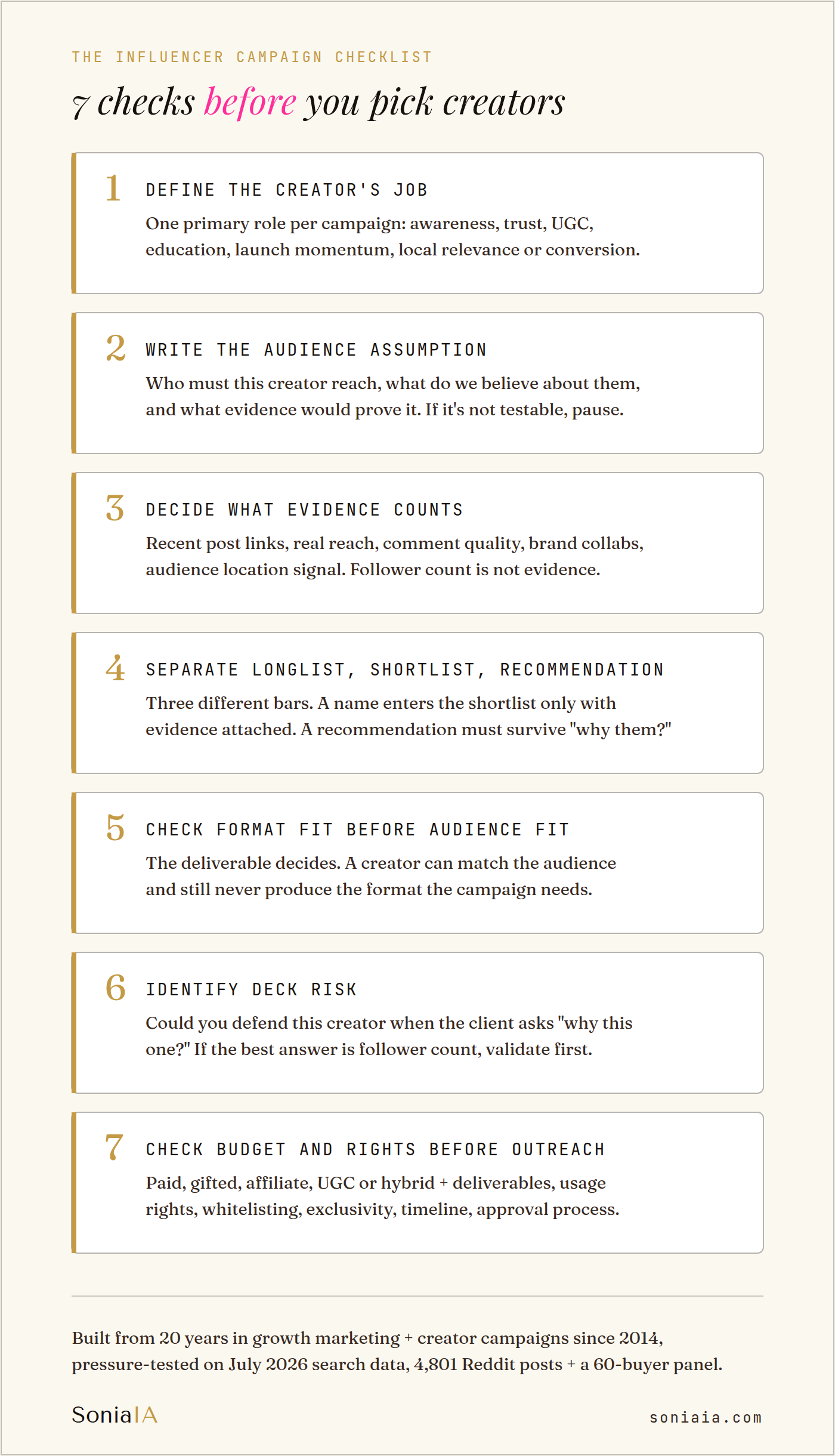
An influencer campaign checklist defines the campaign goal, creator role, audience assumption, evidence standard, budget model, and approval gate — before you pick creators. The real job is simple: stop the team from recommending creators while the campaign logic is still too vague to defend.
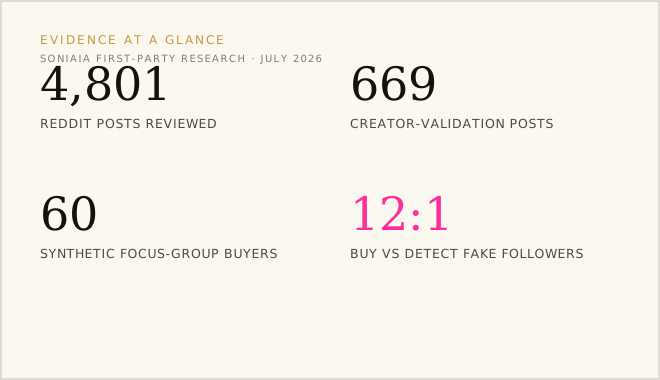
This checklist comes from running creator campaigns since 2014, inside twenty years of growth marketing — pressure-tested against first-party research: July 2026 search data, 4,801 public Reddit posts, and a 60-buyer synthetic focus group run on our proprietary tool. The full research is below the checklist.
TL;DR
An influencer campaign checklist is the set of checks a team runs before picking creators, so the shortlist can be defended when someone asks "why this creator?". The 7 checks:
- Define the creator's job in the campaign.
- Write the audience assumption each creator must satisfy.
- Decide what evidence counts.
- Separate longlist, shortlist and recommendation.
- Check format fit before audience fit.
- Identify deck risk — could you defend this creator to a client?
- Check budget and rights before outreach.
The checklist is built from 20 years in growth marketing, running creator campaigns since 2014, and pressure-tested against first-party research: July 2026 search data, 4,801 Reddit posts and a 60-buyer synthetic focus group. What that research found:
- The sharpest buyer pain is clean metrics with the wrong audience — authentic-looking creators who still fail fit or purchase-intent for the brief. The panel raised it unprompted, #1 by frequency and severity.
- People search like they need a template; the real problem is defending the decision in front of a client, founder or manager.
- Fraud is the measured floor: Google Ads estimates 165,000 monthly searches worldwide for “buy ig followers,” while our TikTok snapshot found sellers in 27 of the first 30 “smm panel” results. Rule it out first; the decision lives above it.
Those six are the planning pass. The security step is validating the creators themselves — an independent read on who they really are, who's actually watching, and whether they're brand-safe. If you already have candidate handles, Creator Validator runs that step before any name reaches the deck.
Table of Contents
- What To Check Before Choosing Influencers
- The Influencer Campaign Checklist
- The Checklist To Copy Into Your Campaign Plan
- Influencer Tracking Tools, Platforms and Validation: Which Layer Do You Need?
- When Should You Validate an Influencer Shortlist?
- The Research Behind This Checklist
- What People Search For: Influencer Tracker, Report and Vetting Demand
- What Marketers Say on Reddit About Influencer Campaigns
- What Buyers Say on the Review Sites
- The Synthetic Focus Group: 60 Agency-Side Buyers
- FAQ
- Methodology
- About the Author
What To Check Before Choosing Influencers
Before you choose influencers, run the 7 checks of the influencer campaign checklist:
- Define the creator's job in the campaign.
- Write the audience assumption each creator must satisfy.
- Decide what evidence counts as proof of audience and format fit.
- Separate longlist, shortlist and recommendation.
- Check format fit before audience fit.
- Identify deck risk: could you defend this creator to a client?
- Check budget and usage rights before outreach.
If any of those are unclear, pause creator collection. The next step is clearer planning, then shortlist.
The Influencer Campaign Checklist
Use this before you search for creators, build a longlist, or ask for rates.
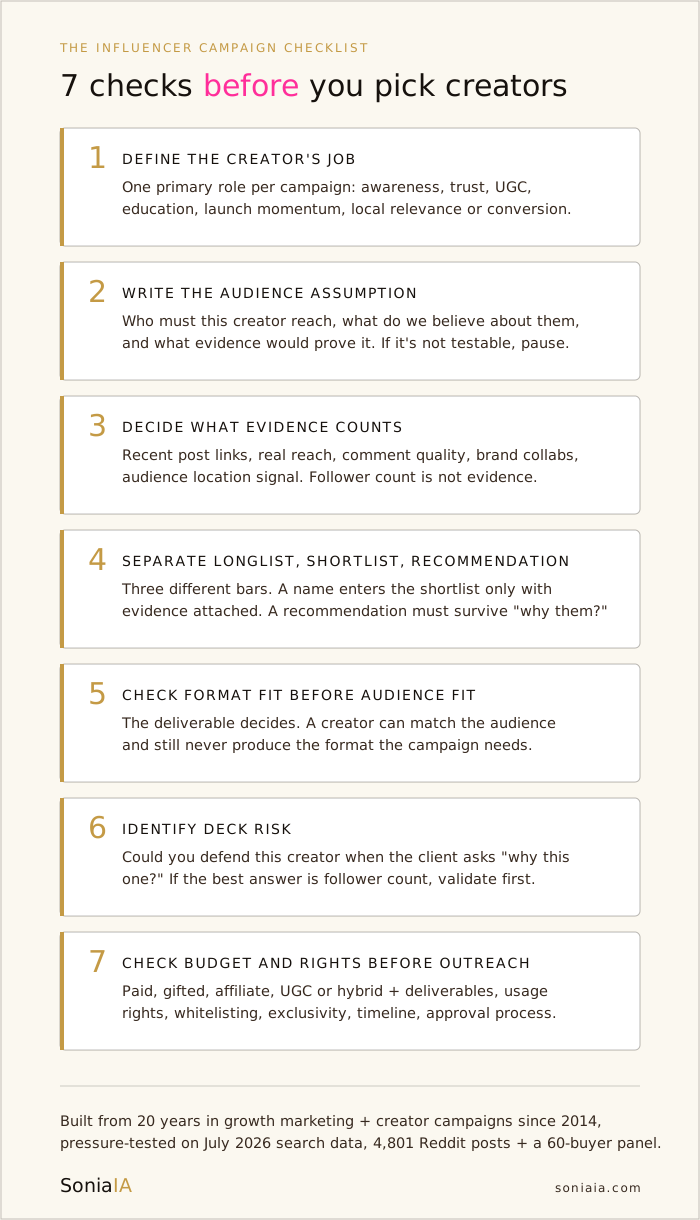 The influencer campaign checklist at a glance. Download the infographic as PNG to use in your own campaign planning.
1. Define The Creator's Job
Start with the creator's job in the campaign, before follower count. Choose the primary role:
| Creator role | What it means |
|---|---|
| Awareness | Make the brand visible to the right people |
| Trust | Make the brand feel credible |
| UGC | Produce usable content |
| Education | Explain the product or problem |
| Launch momentum | Create visible activity around a moment |
| Local relevance | Help in a market, city, or language |
| Conversion support | Move demand closer to action |
If the answer is "all of the above," the campaign is still too broad. A creator who is strong for awareness may be weak for trust. A creator who makes strong UGC can still have an audience too thin to buy. Each role demands different evidence from the creator's actual content and audience — reading whether a creator genuinely carries the role is the qualitative work.
2. Write The Audience Assumption
Every creator recommendation contains an assumption: we believe this creator reaches people who matter to this campaign. Make it explicit:
We believe this creator reaches [audience] because [observable evidence].
Weak example: This creator is Gen Z and lifestyle.
Better: We believe this creator reaches Spanish-speaking skincare buyers aged 20–34 because her recent skincare posts drive detailed product comments, her audience language is mostly Spanish, and her highest-performing content is routine-led rather than meme-led.
The better version can be checked. The weak version is just a label.
3. Decide What Evidence Counts
Before you shortlist creators, decide what evidence matters. Minimum evidence set:
- Creator handle and platform.
- Three recent relevant post links.
- Average views or reach range.
- Comment quality sample.
- Audience location, language, or market signal.
- Category fit.
- Format fit.
- Brand collaboration history.
- Known concerns.
If the team can't collect this evidence, keep the list as a longlist.
4. Separate Longlist, Shortlist, And Recommendation
| Stage | What it is | Risk if mislabeled |
|---|---|---|
| Longlist | Creators who might be relevant | Too many names, low evidence |
| Shortlist | Creators with enough evidence to review | Weak rationale, missing proof |
| Recommendation | Creators ready to defend to a decision-maker | Deck risk, budget risk, brand risk |
Most messy influencer campaigns confuse a longlist with a recommendation. The quality gate is simple: no evidence, no shortlist. No shortlist, no recommendation. No recommendation, no negotiation.
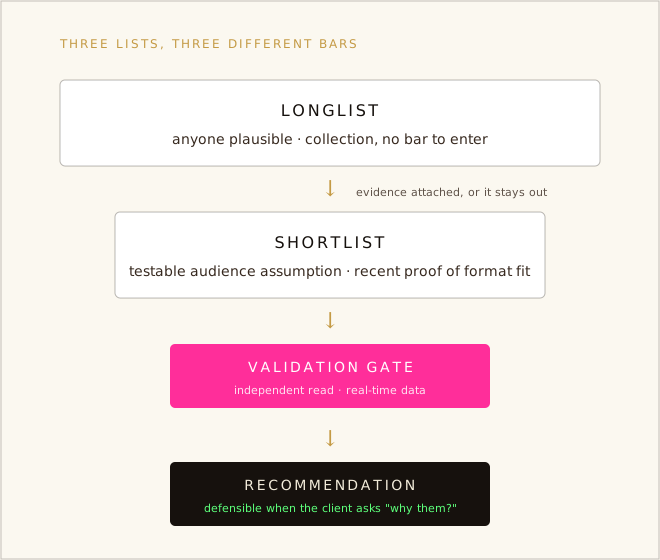 Three lists, three different bars — and the validation gate sits between shortlist and recommendation.
Read top to bottom: four inputs, one verdict conditioned on the brief and the budget, three possible outcomes.The same four reads return a different verdict when only the brief changes.
This is the step Creator Validator runs for you. It's a proprietary system built on this framework: every creator on the shortlist is read against your brief — audience, behaviour, commercial fit, downside — and a human verifies every verdict before it reaches you: approve for shortlist, caution with conditions, or cut or hold. When someone asks "why this creator?", your team answers with an independent, human-checked verdict behind every name.
5. Check Format Fit Before Audience Fit
Audience matters, but format is often the faster disqualifier. Ask:
- Does this creator naturally make the format we need?
- Can the product appear without feeling forced?
- Does the creator have recent examples of similar storytelling?
- Would the required deliverable weaken the creator's normal content?
- Is the creator being chosen for their audience, their content, or both?
If you need testimonial-style Reels and the creator mostly posts static fashion edits, audience fit alone is too weak a defense.
6. Identify Deck Risk
Deck risk is the chance that a creator looks good on the surface but becomes hard to defend when someone asks "why this creator?"
The most common deck-risk signals, at the macro level:
- The rationale is based on follower count.
- The best evidence is old.
- The audience assumption is missing.
- The team can't explain the creator's campaign role.
The full risk read goes much deeper than this — comment quality, format fit, brand-safety history, audience composition — and that depth is exactly what the validation step exists for. If the creator would be awkward to defend in a deck, validate before presenting them.
7. Check Budget And Rights Before Outreach
Send outreach after the commercial shape is clear.
Define:
- Paid, gifted, affiliate, UGC, or hybrid.
- Number of deliverables.
- Usage rights.
- Whitelisting or paid amplification.
- Exclusivity.
- Timeline.
- Revision expectations.
- Approval process.
Negotiation templates are useful after this. Before this, they create false readiness.
The Campaign QA Workflow
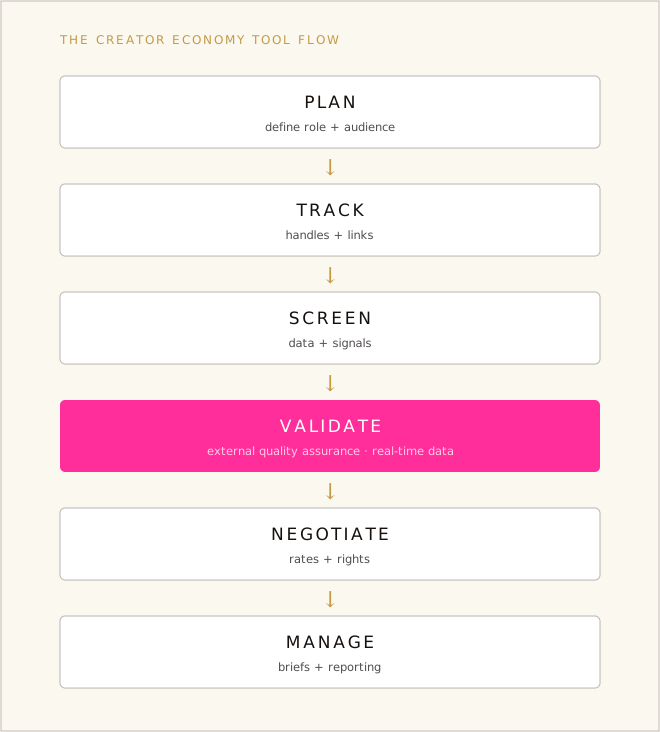
Plan campaign → define creator role → write audience assumption → collect evidence → build longlist → build shortlist → validate creators → brief, negotiate, or present.
| Stage | Main question |
|---|---|
| Planning | What kind of creator would make sense? |
| Longlist | Who might fit? |
| Evidence | What can we prove? |
| Shortlist | Who is worth reviewing? |
| Validation | Who is safe to recommend? |
| Presentation | Who should receive budget, product, or approval? |
The Checklist To Copy Into Your Campaign Plan
| Check | Question | Ready standard |
|---|---|---|
| Objective | What outcome is this creator meant to support? | One primary outcome |
| Creator role | What job should creators do? | One primary role, one secondary max |
| Audience assumption | Who must the creator reach? | Written as a testable assumption |
| Evidence standard | What proof do we need? | Recent posts, comments, reach, audience signal |
| Format fit | Can the creator naturally make the needed content? | Recent examples exist |
| Risk gate | What would disqualify a creator? | Concerns listed before shortlist |
| Validation trigger | When should creators be checked independently? | Before deck, brief, negotiation, or paid test |
| Budget model | Paid, gifted, affiliate, UGC, or hybrid? | Commercial model defined |
| Usage rights | Will the content be reused or amplified? | Rights defined before outreach |
Influencer Tracking Tools, Platforms and Validation: Which Layer Do You Need?
"Influencer campaign tool" can mean at least seven different things, and teams often buy the wrong layer. They need a campaign plan, but grab a tracker. They need creator evidence, but grab a negotiation template. They need an independent read, but treat a spreadsheet as proof.
| Tool layer | Examples | Strength | Limit |
|---|---|---|---|
| Campaign planning checklist | This checklist, brief templates, Notion/Sheets planners | Forces objective, creator role, audience assumption, budget model and approval gate | Does not judge individual creators |
| Influencer tracker / spreadsheet | Google Sheets, Airtable, Notion templates | Stores handles, links, status, outreach, rates, notes | Can make a weak list look more serious than it is |
| Discovery + audience-audit platforms | HypeAuditor, Modash, Upfluence, Traackr | Find creators at scale; screen audience, engagement, growth, fraud and brand-safety signals | Pricing, data refresh and methodology vary by platform and plan |
| Creator CRM + campaign operations | GRIN, Upfluence, Traackr | Outreach, briefs, approvals, content, payments, reporting | Heavier setup and recurring cost — built for always-on programs |
| Social listening + brand-safety monitoring | Listening tools, platform alerts | Catches mentions, sentiment and content risk | May miss whether the creator fits this campaign's exact role |
| External quality assurance | Creator Validator | Human-reviewed creator QA on real-time data, with a clear verdict — approve for shortlist, caution with conditions, or cut or hold — before the shortlist reaches the deck | Works once you have candidate handles |
| Negotiation + contract templates | Rate cards, usage-rights templates, legal workflows | Clarifies scope, payment, exclusivity, rights | Premature if creator fit is still unclear |
There is nothing wrong with the software layers — discovery platforms and creator CRMs earn their place in always-on programs. The layer the stack has been missing sits between screening and negotiation: an independent check, on real-time data, at the exact moment a shortlist becomes a recommendation. Discovery tools handle the search and trackers handle the ops, but nothing in the stack answers "should THIS creator move forward on THIS campaign?" — and that's the question the deck, the founder and the client actually ask.
That's the layer external quality assurance occupies, and it's where Creator Validator sits: after screening, before negotiation and the deck. Every validation returns one verdict per creator — approve for shortlist, caution with conditions, or cut or hold — with the reasoning and the evidence to request before the creator moves forward.
Quality questions to ask ANY tool in the stack:
| Quality question | Why it matters |
|---|---|
| When was the creator profile last refreshed? | A creator can change format, audience, or commercial behavior quickly |
| Which signals refresh daily, weekly, monthly, or on request? | Follower counts can update daily while audience-quality analysis lags |
| What does the quality score include? | A score without inputs is hard to defend in a client conversation |
| Does the tool understand the campaign role? | A creator can look strong in general and still be wrong for this campaign |
| Is there human review before the recommendation? | Data flags risk. Human judgment decides whether the risk matters |
| Can the team export the rationale? | The approver needs receipts beyond a dashboard screenshot |
When Should You Validate an Influencer Shortlist?
The campaign is ready for external quality assurance once you have your shortlist.
Use Creator Validator before:
- Sending the shortlist to a client.
- Sending creators to a founder or CMO.
- Requesting rates.
- Sending products.
- Building a campaign deck.
- Starting paid usage or amplification.
If you're still at the planning stage, work through the checklist above first — validation is for when real names are close to a real decision.
Once you have names, how to vet influencers before a campaign covers the five checks in order, and the influencer audit template is the memo that records each call.
The Research Behind This Checklist
Most influencer campaign advice is written from other influencer campaign advice. This checklist is written from experience — creator campaigns since 2014 — and checked against three first-party evidence layers, two public, one proprietary. Four findings from that research sharpened the items above.
| Evidence layer | What we reviewed | Main finding |
|---|---|---|
| Search intelligence (public) | July 2026 search and AI Overviews demand data | Searchers ask for trackers and templates first |
| Reddit demand scan (public) | 4,801 posts from marketing, creator, social, startup and growth subreddits — 669 in the creator-validation cluster | The live language is rates, reach drops, audience fit, and shortlists that feel indefensible |
| Synthetic focus group (proprietary) | 60 synthetic agency-side buyers on Synthetic Audience, our in-house consumer-research tool | The #1 pain, raised unprompted: clean metrics with the wrong audience |
The four findings:
1. The buyer's real fear has moved past fake followers. Given five open questions and no product to react to, the focus group converged on creators whose metrics are clean and authentic — and whose audience still doesn't fit or buy for the specific brief. The verdict that matters isn't "is this creator real?" It's "is this creator right?"
2. The market searches for templates but suffers from decisions. The query data asks for trackers and spreadsheets. The Reddit posts ask about rates, reach drops, audience quality, and defending a shortlist. The template is what people think they need on day one; the decision gate is what they're missing on day thirty.
3. The cost of skipping the gate is already public. 111 posts in the corpus describe spend that went wrong — flopped campaigns, burned budgets, suspected scams, reach without sales.
4. Fraud is the measured floor. Our fake-follower market research puts named-query evidence on it: Google Ads estimates 165,000 monthly searches worldwide for “buy ig followers,” including close variants. Rule the fakes out first, then make the actual call, which is about fit.
What People Search For: Influencer Tracker, Report and Vetting Demand
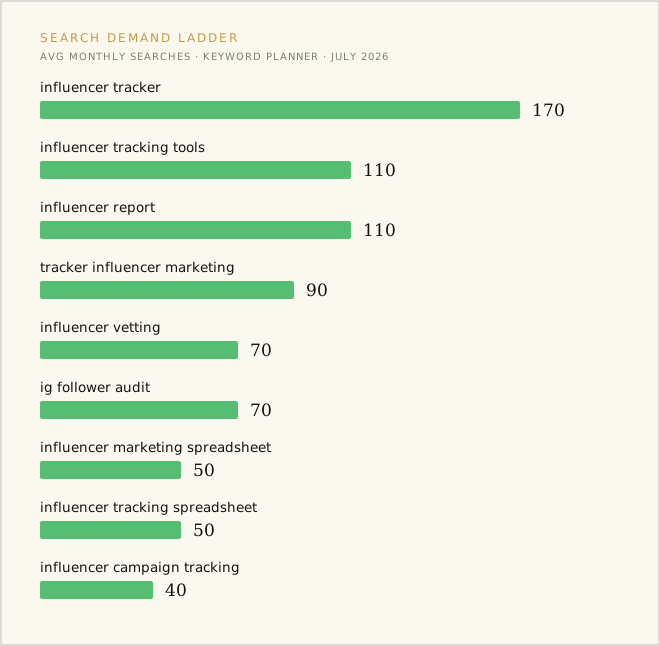
Average monthly searches, July 2026 (full data for reference):
| Query | Avg. monthly searches | Observed intent |
|---|---|---|
| influencer tracker | 170 | Find a tool or spreadsheet |
| influencer tracking tools | 110 | Compare software |
| influencer report | 110 | Build evidence for decisions |
| tracker influencer marketing | 90 | Organize campaign workflow |
| influencer vetting | 70 | Reduce creator risk |
| ig follower audit | 70 | Check audience quality |
| influencer marketing spreadsheet | 50 | Download a template |
| influencer tracking spreadsheet | 50 | Manage creator lists |
| influencer campaign tracking | 40 | Monitor activity |
Current ranking pages are mostly generic checklists, spreadsheet and Notion templates, platform-owned tool pages, and broad discovery articles. The gap is a practical, first-party planning framework: what must be true before a creator shortlist is worth building.
What Marketers Say on Reddit About Influencer Campaigns
Search data tells us the public query. Reddit tells us the messy version of the problem — in the 669 creator-validation posts, these themes recur (counts overlap; one post can carry several):

| Theme | Posts | What it means for campaign planning |
|---|---|---|
| Creator, UGC or influencer sourcing | 485 | People are still trying to find the right supply of creators |
| Audience quality, engagement or fit | 301 | Audience usefulness matters more than account size |
| Pricing, rates, budget or cost | 282 | Teams hit commercial uncertainty before they are ready to negotiate |
| Reach drops, views, algorithm volatility | 235 | A creator can look strong historically and still be unstable now |
| Brand deals, sponsorships, paid partnerships | 209 | The market matches creators and brands constantly, but the quality gate is vague |
| Monetization uncertainty | 209 | Creators with reach still struggle to turn attention into sponsor value |
| Workflow, outreach, briefs, contracts, tracking | 144 | Creator marketing becomes ops-heavy fast |
| Fake, bot, pod, inflated, scam | 113 | Fraud matters — but it's one risk inside a broader creator-quality problem |
Failed Campaigns and Wasted Budget, In Their Own Words
111 distinct posts describe money that already went wrong — content that flopped (30 posts), suspected scams (37), burned budget (24), campaigns with views but no sales (11). This is the after-picture of a creator decision made without a quality gate. Four of those posts, as they appear on Reddit — usernames removed, live threads linked:
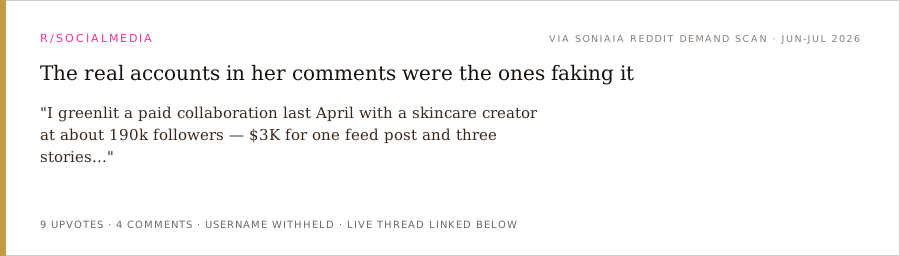 Live thread → — $3,000 spent before discovering the engagement was staged by real accounts.
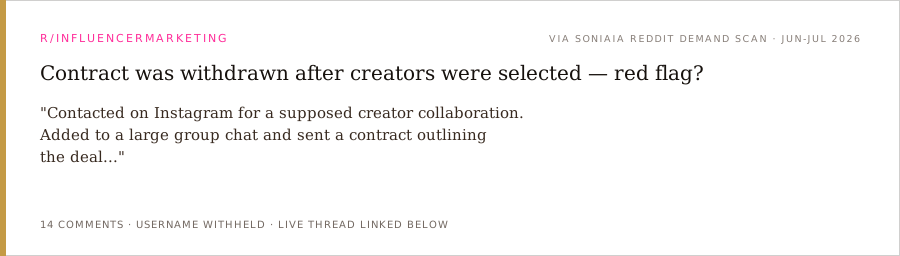 Live thread → — deals collapse late when vetting happens after commitment.
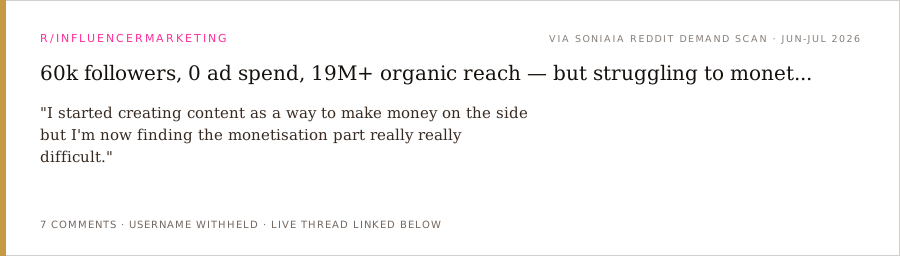 Live thread → — reach and commercial value are different signals.
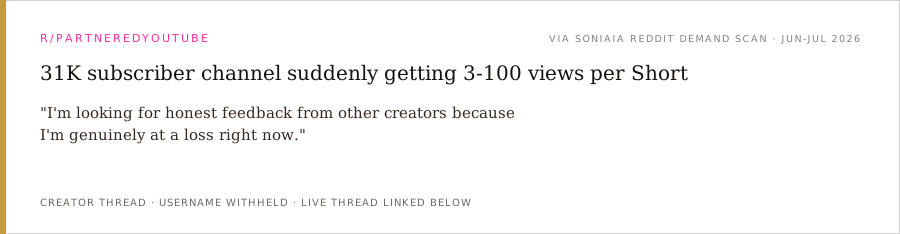 Live thread → — yesterday's audience size defends nothing.
The public version of the same story.
- Arii, May 2019: an Instagram creator with 2.6 million followers couldn't pre-sell the 36 T-shirts her manufacturer needed to start the line. BuzzFeed News
- Amy Chan, 2026: a $10,000 TikTok creator campaign for her book UNSINGLE tracked three sales — "$3,333 per book" in her own words. Her post
- Bushbalm (David Gaylord, on Shopify's blog): "One time, we spent $2,500 and got back more than $65,000 in sales. The next time we spent $10,000 and got back less than $5,000." Same brand, same channel, opposite results. Shopify
None of the three had a gate between "this creator has reach" and "this creator's audience buys this thing."
And the authenticity layer under all of it is measurable. Our fake-follower market research found 165,000 estimated monthly searches worldwide for “buy ig followers” and sellers in 27 of the first 30 TikTok results for “smm panel.” Some creators in any longlist are not what they appear to be. That is not paranoia; it is a documented buying ecosystem.
The consumer insight: the first language is rarely "I need creator validation." It starts as:
- I need creators for this campaign.
- The fair rate is unclear.
- This creator has views, but brand value is unclear.
- My reach dropped and the audience might be stale.
- Follower count seems weak as a brand-deal predictor.
- I have a shortlist, but the defense is weak.
What Buyers Say on the Review Sites
Buyers complain about paying for scale they never use, dashboards that hand back a score instead of a verdict, and reach numbers that don't hold up once you ask the creator for a screenshot.
"most influencer tools are built for specialists running programs full-time — overkill (and over-budget) for teams that plug creator strategy into broader client work." — marketing lead, G2
"We send our selection of influencers to the client and they check their own platform and say that there's no coincidence in the ER of the same profile." — PR lead, mid-market agency
"I wish I could purchase the discovery tools and not be forced to pay for features I don't use. I need reports on the influencers I follow and pretty much nothing else." — agency founder (a five-star reviewer)
"Estimated reach presents numbers that are far from reality. I discovered this when I asked one of my influencers to send a screenshot of their analytics." — influencer coordinator, enterprise
"It makes influencer recommendations defensible in a client conversation, which is ultimately what the job requires — rather than relying on vibes, decks from the talent side, or a patchwork of free tools." — G2 reviewer
Nobody in that list is asking for another dashboard. They're asking for a verdict a client can't argue with, and most of them are billed for a full platform's worth of seats and discovery credits to get the two or three things they actually open the tool for.
Honesty note: about 18 distinct complaint voices, scraped 2026-07-04 across G2, Capterra and Trustpilot. Directional, quoted for the pattern, never as market statistics.
The Synthetic Focus Group: 60 Agency-Side Buyers
This is the layer no other influencer checklist has.
Before writing a single checklist item, we ran a focus group on Synthetic Audience — SoniaIA's proprietary synthetic-research tool. The respondents are built on a synthetic dataset grounded in US-census-representative consumer profiles, recast as the people who actually approve creator spend: media buyers, account leads and strategists. The setup:
- 60 synthetic agency-side buyers.
- 5 open questions. Zero product mention. No leading, no feature list, nothing to react to.
- 405 pain statements came back, clustered and ranked by how many buyers raised each pain and how severe they rated it.
What the panel raised unprompted — the #1 pain by both frequency and severity:
Clean metrics with the wrong audience. Buyers already have authenticity scores from their platforms. Those scores keep passing creators who then don't convert — because the audience is entertainment-led rather than purchase-intent, or simply doesn't fit the specific brief.
We had hypothesized the usual suspects: time, effort, wasted spend. The panel went somewhere more specific — the fear isn't fake followers anymore, it's real followers who don't matter for this campaign. Dozens of variations of the same wound.
Honesty note: these are synthetic respondents, and we treat the results as directional evidence — a rehearsal of the market rather than proof of demand. But the finding lines up independently with the 669 Reddit posts and with our review-site mining across the vetting category. Three data sources, one conclusion.
That conclusion changed the checklist: it separates audience size from audience usefulness at every step.
FAQ
What is an influencer campaign checklist? A planning tool that defines the campaign's goal, audience and approval standards before creators are selected — so the shortlist can be defended later.
What should you check before choosing influencers? The campaign fundamentals first — objective, audience, budget and who approves. Then each creator's real content and audience. The deeper qualitative reads are what decide success, and that's the validation step.
Is an influencer tracker the same as an influencer campaign checklist? No. A tracker stores names, posts, outreach, status, and campaign activity. A checklist decides what must be true before a creator belongs in the shortlist.
Do you need influencer marketing software? Useful when you need ongoing discovery, outreach, CRM, campaign tracking, payments, and reporting. For early planning, a checklist is enough. For shortlist decisions, independent creator validation is more useful.
What is the difference between tracking and validating creators? Tracking stores creator and campaign activity. Validation judges whether specific creators can actually deliver — who they really are, who's actually paying attention, how commercial that audience is, and whether they're safe for the brand — before they enter a deck, brief, negotiation, or paid test.
Should you negotiate with influencers before validating them? Usually no. Negotiation should happen after you know the creator fits the campaign role, audience assumption, format need, budget model, and brand-safety standard.
When should a creator shortlist be validated? Once you have the candidate handles, and before you send the list to a client, founder, manager, or campaign owner.
Use the checklist for the first pass. Use Creator Validator for the decision. If the shortlist already exists, check the creators before they reach the deck.
Methodology
- Search intelligence: search and AI Overviews demand data (volumes from Google Keyword Planner). Run: July 2026.
- Reddit demand scan: 4,801 public posts from marketing, creator, social, startup and growth subreddits, 2026-06-15 to 2026-07-05, classified into demand clusters; 669 posts in the creator-validation cluster. Counts overlap because one post can carry several themes.
- Synthetic focus group: 60 synthetic agency-side buyers run on Synthetic Audience, SoniaIA's proprietary consumer-research tool, built on a synthetic dataset grounded in US-census-representative consumer profiles, recast as agency-side buyers. 5 open questions, no product mention, 405 pain statements, clustered and ranked by frequency × severity. Treated as directional evidence.
- Category review: platform-user feedback across public review sites for the influencer-vetting category, treated as directional.
- Review-site scan: ~18 distinct complaint voices across G2, Capterra and Trustpilot for the influencer-vetting category, scraped 2026-07-04. Directional; quoted for pattern, never as market statistics.
Related first-party research: the fake-follower market study, 2026, with worldwide and six-country named-query estimates from Google Ads plus Google Trends, Reddit and platform-search evidence.
About the Author
Sonia Tamayo is the founder of SoniaIA, an AI growth systems practice in Madrid — the same stack this research was produced with.
20 years in growth, media, performance and brand strategy: roughly 10 years inside agency groups — MindShare (WPP), Starcom (Publicis), Carat + iProspect (Dentsu) — with media and growth work for Unilever, Samsung, Nokia, Alfa Romeo, Kellogg's and Microsoft Iberia, and roughly 10 years building independently. Running influencer campaigns since 2014.
Recognition: 2014 EMEA Market of the Year (Kellogg's account, as Account Director) · 2013 Best European Activation (Kellogg's) · 2011 Star Performer of the Year, Innovation (Aegis Media, Spain) · 2011 Working Together, Global Aegis Media Awards.