The same creator can be a yes for one campaign and a no for the next. Due diligence is judged against a brief and a budget, not the person: is the audience real and right, does the behaviour fit, and what's the downside if it goes wrong. Most pages treat the term as a compliance exercise — disclosure rules, contract clauses, policy templates. That skips the question a buyer actually has: whether to spend the money on this person, for this campaign.
TL;DR
A creator isn't good or bad — only a fit or a miss for a specific brief at a specific budget. The Brief-Conditioned Creator Fit Framework has four inputs:
- The brief — what to achieve, and who to reach.
- The audience read — is the audience real, and is it the right one.
- The behaviour read — how they post, respond, and sell.
- The downside read — the cost and visibility if it goes wrong.
Those four combine into one of three calls: approve for shortlist, caution, conditions apply, or cut or hold. Change the brief, and the same four reads can call the same person differently.
What backs the framework:
- The sharpest cost is a real audience that doesn't fit the brief. A 60-buyer synthetic panel ranked this unprompted as the #1 pain: clean metrics, wrong audience. Source
- Fraud sets a measured floor under the category. 165,000 estimated monthly searches worldwide for "buy ig followers." The full study
- The failure is already documented. 111 posts in our Reddit corpus describe money that went wrong on creator campaigns. Source
If you already have candidate handles, Creator Validator runs this framework for you, verdict by verdict.
Table of Contents
- Why the Permanent Verdict Is the Wrong Question
- The Brief-Conditioned Creator Fit Framework
- One Creator, Two Briefs, Two Verdicts
- What the Framework Does Not Judge
- Where the Risk Actually Sits
- Running It
- What We Measured
- Related in This Series
- FAQ
- Methodology
- About the Author
Why the Permanent Verdict Is the Wrong Question
The permanent verdict is the wrong question: a creator isn't good or bad in the abstract, only a fit or a miss for one brief and budget. Most teams keep a mental list anyway — good creators, bad ones, the one who was difficult last time. Efficient, and expensive.
It costs both ways: good creators get refused over a memory from a campaign with a different objective, and weak matches get approved because someone remembers them performing, without checking what for.
A creator whose audience buys skincare on impulse is a strong yes for a launch and a weak yes for a considered high-ticket product — nothing about the creator changed, only what was being sold.
So the useful unit isn't the creator — it's the pairing: this creator, this brief, this budget. You re-read before each campaign; the check is faster the second time, but the verdict never is.
The Brief-Conditioned Creator Fit Framework
The Brief-Conditioned Creator Fit Framework combines four reads — the brief, the audience, the behaviour, and the downside — into one of three verdicts. Three of the four come from the creator's public behaviour; one comes from you, and it's the one that gets skipped.
Read top to bottom: four inputs, one verdict conditioned on the brief and the budget, three possible outcomes.The same four reads return a different verdict when only the brief changes.
Input 1 · The Brief
One line, written before any profile is opened.
What this campaign has to achieve, and who it has to reach.
Without it, every check is a quality judgment with no threshold: "engagement looks good" is a compliment, "engagement looks good, but the people who comment are other creators, not buyers" is a finding.
The one-line brief, in five parts:
- Objective — what the campaign must achieve
- Audience — who it has to reach
- Format — what the creator makes, and where it runs
- Commitment — one post, a short series, or ongoing
- What would make this a no
Input 2 · The Audience Read
Two questions, in order — the second is cheaper to answer, and the first disqualifies faster.
Is it the right audience? Who comments, who the creator addresses, and the language and geography of the people who comment.
Is it a real audience? Follower growth shape over time, engagement against the creator's own category and size, and whether the people who comment have history of their own.
Authenticity runs second on purpose — cheapest signal to check, which is why it rarely killed the campaign. More here.
Input 3 · The Behaviour Read
How the creator operates when money is involved: how often they post paid content, how many categories they've sold in recently, and how they handle a product that disappointed them — what happens if yours does.
This read is where saturation shows up, one of the two most expensive misses in creator marketing.
Input 4 · The Downside Read
What it costs if this goes wrong, and how visible that is. A gifting seed with a micro creator and a national launch with a household name raise the same authenticity question, with very different downside — this read decides how much diligence the spend deserves.
How the Four Combine
The four reads don't add up to a score. They combine into one of three calls — approve for shortlist, caution with conditions apply, or cut or hold — reasoned out in Making the Call.
This is the moment Creator Validator runs the framework for you. Send the handles and the brief. Get one verdict per creator, with the reasoning and evidence behind it, reviewed by a senior practitioner within 24–48h.
One Creator, Two Briefs, Two Verdicts
The same creator can clear one brief and fail the next because the verdict is conditioned on the brief. Here's one real pattern, sanitized.
Nothing about the creator changed between these two reads. Only what the money was trying to do changed. Audience real and in category. High recent paid frequency doesn't matter for awareness, and downside is low. Same audience, same person — but the audience follows for aesthetics rather than to buy, and the quarter-long commitment raises the downside.Same creator, same audience. The brief decided the verdict.
A creator with roughly 90,000 followers in home and interiors. Steady growth across three years, comment threads specific and conversational, four paid posts in the last two months across three categories.
Brief A: a furniture brand launching a new range, objective is awareness, format is three organic posts.
Approve for shortlist. Audience real and squarely in category. Paid frequency is high, but awareness doesn't depend on conversion, and the creator's tone survives being cut into paid ads. Downside is low: one range, no exclusivity, no long-term association.
Brief B: the same creator, a home-insurance product, objective is qualified leads, format is a paid partnership over one quarter.
Cut or hold. Same audience, same authenticity, same person. Home and interiors overlaps with home insurance in category language, not in buying intent. The audience follows for aesthetics; a lead-generation ask puts the creator in a tone it's never seen. The quarter-long commitment turns a partial fit into an expensive one.
Nothing changed except what the money was trying to do. A permanent verdict would have gotten one of those two calls wrong.
What the Framework Does Not Judge
The framework does not judge rates, the person, future performance, or the contract — stating that boundary is part of the method.
It does not judge rates. What the creator charges is a negotiation, informed by the check but separate from it.
It does not judge the person. Class, background, income, appearance, or any protected characteristic — only public professional behaviour: what they publish, who responds, how they handle commercial work.
It does not predict performance. No honest check promises a return number, only whether the spend's assumptions survive contact with the evidence.
It does not replace the contract. Rights, exclusivity, disclosure and usage are legal work; diligence tells you whether to start that conversation.
A framework claiming all of that oversells what a check can tell you.
Where the Risk Actually Sits
Most of the risk in creator marketing sits in audience mismatch and commercial saturation. Fake followers — the risk most vetting tools chase hardest — is the smallest class by cost.
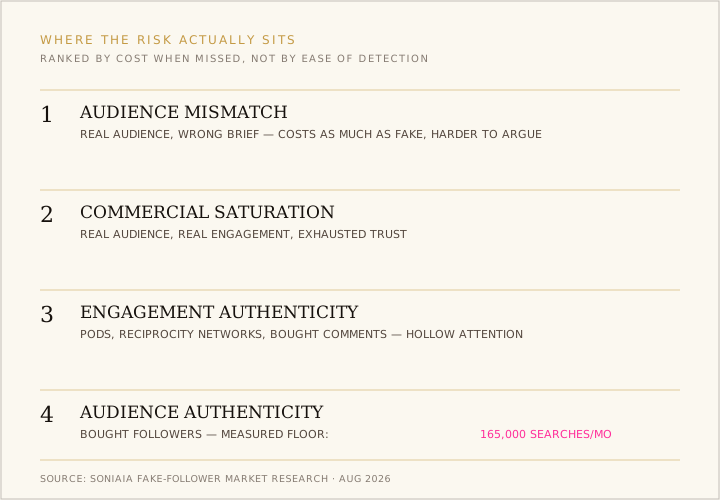 Ranked by how often each class actually sinks a campaign, ordered top to bottom by cost.
Audience mismatch. A real audience that doesn't match the brief costs as much as a fake one, and is harder to argue against — the sheet still looks fine.
Commercial saturation. The audience has seen this creator sell too many things recently: real audience, real engagement, exhausted trust.
Engagement authenticity. Pods, reciprocity networks, bought comments: real accounts, hollow attention.
Audience authenticity. Bought followers — the risk sold hardest, and cheapest to detect.
Our own market research puts a measured floor under that last class: 165,000 estimated monthly searches worldwide for "buy ig followers." The full study. Rule it out early, then spend attention on the two risks above it — detection method and limits on influencer fraud detection.
Running It
Running the framework means putting it into working documents, one for each stage of the check.
Before the check: how to vet influencers before a campaign — five checks, cheapest disqualifier first.
During the check: the influencer audit template — the one-page memo that records the call for each creator.
And before any of it, the campaign checklist, the planning pass that produces the brief.
What You Supply
For the check to be brief-conditioned, somebody has to supply the brief: what the campaign must achieve, who it must reach, and the commitment. Without it, the check still works, but becomes an audit of a creator in isolation — the failure mode this page exists to name.
Doing It at Volume
Creator Validator is the automated version — handles and brief in, one reviewed verdict per creator out.
What We Measured
Two first-party evidence layers back the framework above: a synthetic panel of buyers, and a measured floor under fraud.
No single creator is scored against these numbers. They're why the framework spends more effort on fit than on authenticity.Audience fit was the #1 pain buyers raised — unprompted.
“Clean metrics with the wrong audience.”the pain raised unprompted, ranked #1 by frequency and severity
We ran a synthetic focus group of 60 agency-side buyers on Synthetic Audience, SoniaIA's proprietary research tool — five open questions, no product mention, 405 pain statements ranked by frequency and severity. The pain raised unprompted, ranked #1 by both measures: clean metrics with the wrong audience.
Buyers already trust the authenticity scores their own platforms give them, and those scores keep clearing creators whose audience doesn't convert — entertainment-led rather than purchase-intent, or simply wrong for the brief. Full method and findings.
The same corpus counts 111 Reddit posts describing money that already went wrong, and puts the fraud floor at 165,000 monthly searches for "buy ig followers" — both covered above. Reddit corpus · Fraud study. None of these numbers judge a specific creator — they're why the framework spends more effort on audience fit than on authenticity.
Related in This Series
- Influencer Campaign Checklist — plan the campaign before picking creators.
- How to Vet Influencers Before a Campaign — the five checks, in order.
- Influencer Audit Template — the one-page memo that records each call, free to copy.
- Influencer Rate Cards: What to Pay and How to Negotiate — what brands actually paid by tier, and how to negotiate once the call is made.
FAQ
What is creator due diligence? The check run before paying a creator: is the audience real and right for the brief, does the behaviour fit, and what's the downside if it goes wrong. Judged against one brief and one budget.
What does due diligence in influencer marketing cover? Four reads: the audience (real, and right), the behaviour (how the creator posts, responds and sells), the brief (what the campaign has to achieve), and the downside (cost and visibility if it goes wrong).
How is creator due diligence different from an influencer audit? An audit assesses one creator, written up as a document. Due diligence is the wider practice — the standard held before money moves, repeated per campaign. The audit is one output of it — here's a free influencer audit template.
Do you need to repeat due diligence for every campaign? Yes — the verdict is tied to a brief and a budget, not the creator. The same person can be approved for a launch and held for a performance campaign with nothing changed on their side. Re-read ongoing partners before each renewal.
What should a creator due diligence policy include? Who signs off, what evidence is required before a name reaches a client, the fixed set of outcomes a reviewer can return, what the check deliberately doesn't judge, how long a read stays valid, and what happens when a check can't be completed.
Is creator due diligence only about fake followers? No. Fake followers are the cheapest signal to detect and rarely the reason a campaign fails. Audience mismatch and commercial saturation cost more and are harder to argue with, because every number on the sheet looks fine while the campaign returns nothing.
The framework is free to use. Creator Validator is the version that runs it for you. Send the handles and the brief.
Methodology
- Framework: the Brief-Conditioned Creator Fit Framework is the standard the Creator Validator engine applies, stated here in full.
- Synthetic focus group: 60 agency-side buyers on Synthetic Audience, SoniaIA's research tool, 5 open questions, 405 pain statements, ranked by frequency × severity. Directional evidence, reused from the campaign checklist research.
- Reddit demand scan: reused from the same corpus — 4,801 public posts, 111 describing wasted spend.
- Market evidence: figures on the fake-follower market come from our own published study, measured from worldwide Google Keyword Planner data.
- Worked case: sanitized composite from creator assessments run in 2026. No client, creator or campaign is identifiable.
About the Author
Sonia Tamayo is the founder of SoniaIA, an AI growth systems practice in Madrid — the same stack this research was produced with.
20 years in growth, media, performance and brand strategy: roughly 10 years inside agency groups — MindShare (WPP), Starcom (Publicis), Carat + iProspect (Dentsu) — with media and growth work for Unilever, Samsung, Nokia, Alfa Romeo, Kellogg's and Microsoft Iberia, and roughly 10 years building independently. Running influencer campaigns since 2014.
Recognition: 2014 EMEA Market of the Year (Kellogg's account, as Account Director) · 2013 Best European Activation (Kellogg's) · 2011 Star Performer of the Year, Innovation (Aegis Media, Spain) · 2011 Working Together, Global Aegis Media Awards.